In January 2026, Novis completed the transition of our Information Security certification from ISO/IEC 27001:2013 to ISO/IEC 27001:2022, and we have valid certificates confirming this update. The 2022 version of the standard reflects the evolution of today’s risk landscape and the security controls organizations are expected to maintain.
You can view and download the digital certificates validating our ISO/IEC 27001:2022 certification here:
Since our early days, Novis has implemented best practices to operate mission-critical services and platforms with enterprise-grade standards. We’re pleased to share that we closed 2022 with a positive result in our annual ISO/IEC 27001 audit—certification that supports our Information Security Management System (ISMS).
This certification provides our customers with confidence that we manage information under an internationally recognized framework, with a strong focus on continuous improvement.
What is ISO/IEC 27001?
ISO/IEC 27001 defines the requirements to establish, implement, maintain, and continually improve an ISMS. In practical terms, it aims to ensure the well-known CIA principles:
ISO/IEC 27001 compliance supports our work to reduce risks related to cybersecurity and the operation of critical systems—helping prevent unauthorized access, security incidents, and information exposure, among other threats.
Digital certificates — ISO 27001:2013
Contact: For more information about our services, please contact us.
The adoption of artificial intelligence (AI) agents in business is redefining how organizations automate processes, scale operations, and enhance user experience. Unlike traditional models, AI agents are not merely chatbots — they are autonomous assistants capable of executing complex tasks, querying systems, making decisions, and adapting to business context.
One of the pillars of this new generation of AI agents is freedom of choice. Companies can deploy agents on any model (GPT, Claude, Mistral, etc.) and any cloud provider (Azure, AWS, GCP, or on-premise), without being locked into a single technology.
This flexibility enables organizations to tailor the solution to their specific needs, optimizing cost and performance.
However, such freedom must come with strong guarantees of security and privacy. Enterprise agents operate with sensitive data, access internal systems, and can make decisions that directly impact the business. Therefore, their design must include:
In our webinar Enterprise AI Agent Adoption Strategy, we presented the MCP protocol and the technical architecture we propose to embed security by design—ensuring agents operate reliably and in alignment with each client’s corporate policies.
As part of our responsible innovation strategy, we established an alliance with Qualifire, a platform specialized in generative AI security and reliability.
Through Qualifire, we offer clients a set of advanced tools to deploy AI agents with built-in security controls from day one. Its free version includes:
Through this partnership, we deliver a comprehensive value proposition: technological freedom, operational efficiency, and world-class security. With Qualifire, the AI agents we implement are not only intelligent — they are also trustworthy, auditable, and secure.
Feedback or discussion with the author: Patricio Artiagoitia, Executive Director at Novis.
If you’d like to learn more, contact us.
We’re proud to announce that Novis has obtained two certifications granted by SAP under the SAP Certification for Operations Partners program:


Both certifications officially qualify Novis as an SAP Operations Partner, valid until July 31, 2027. They formally validate our capabilities in SAP environment operation, monitoring, and continuous improvement. Below we explain what they mean — and why they represent a significant advantage for companies that trust Novis.
These certifications are granted by SAP after a rigorous audit process that evaluates a provider’s ability to implement, operate, and continuously improve SAP solutions.
The certification process included a review of our service portfolio, technical controls, team competencies, security practices, operational performance, service governance, and continuous improvement management. In every dimension, Novis was measured against SAP’s strict standards to ensure quality, reliability, and best-practice alignment.
Key highlights include:
The audit represents a snapshot of Novis’ current operational excellence — highlighting how our practices evolve in step with SAP technology to maintain a consistently high level of service quality.
Being a certified SAP Operations Partner is far more than a label. It delivers tangible and strategic benefits to organizations that choose Novis as their technology partner.
| Benefit | What It Means for Our Clients |
|---|---|
| Official trust and endorsement | SAP formally recognizes and validates our processes, giving clients confidence that their SAP operations are in qualified hands. |
| Operational quality and consistency | Activities like monitoring, patching, backups, and system improvements follow strict SAP best-practice standards. |
| Visibility in official SAP Partner directories | Certification ensures Novis appears in SAP’s official listings, increasing exposure and helping new clients identify reliable providers. |
| Reduced risk and faster recovery | Security controls, automation, and proactive monitoring minimize the likelihood of failures or downtime. |
| Continuous optimization | Improvement plans based on EWA audits help identify and act on ongoing system enhancement opportunities. |
| Co-marketing and joint recognition with SAP | As a certified partner, Novis can participate in SAP-backed events, campaigns, and success-story initiatives. |
| Higher commercial competitiveness | In RFPs and vendor selection processes, certification serves as a strong differentiator versus non-certified competitors. |
| Comprehensive technical coverage | Clients receive complete operational services—covering infrastructure, databases, applications, and security—under one certified quality framework. |
In short, our clients gain a more reliable, efficient, and globally aligned SAP operation — improving everything from system stability to end-user experience.
In an increasingly digital and competitive environment, partnering with a certified SAP provider like Novis is key to ensuring operational continuity, technological innovation, and sustainable growth.
Novis continues to lead the digital transformation of enterprises across the Americas, with a focus on excellence, automation, and strategic partnership.
As a company with strong presence throughout Latin America, this certification strengthens our position as a trusted local SAP partner, capable of delivering operational excellence in SAP HANA and SAP S/4HANA environments. It also reflects our ongoing commitment to innovation, staff training, and adherence to global standards.
For organizations currently running or planning to deploy SAP environments (cloud, hybrid, or on-premise), Novis reinforces its value proposition as a technology partner deeply experienced in SAP operations, officially certified by SAP to ensure them.
Learn more at: Novis SAP Partner for Managed Services
If you’d like to learn how our SAP Operations Partner certification can enhance your migration, daily operation, monitoring, optimization, or SAP support project, contact us. We’d be glad to share success stories and show how we tailor our services to your specific needs.
Written by Gilda Valderrama, Editor – Novis Newsletter
 Coca-Cola Embonor S.A. produces and distributes The Coca-Cola Company portfolio in Chile and Bolivia. It also markets water, juices, and—in Chile—third-party alcoholic beverages, managing a portfolio of over 1,000 SKUs.
The company serves 8.5 million people across its operation zones, with 4 bottling plants, 27 distribution centers, and more than 68,000 customers. Its 24/7 operation runs at a pace that allows no downtime — every second without SAP means suspended delivery routes, delayed billing, and a halted supply chain.
In 2021, Embonor awarded Novis the complete outsourcing of its infrastructure (SAP IT services). In 2024, the company expanded the contract to include functional support (SAP AM services). Together, these services form the SAP AMS model — a fully remote service that ensures zero critical incidents, executive escalation, and frees Embonor’s internal team to focus on innovation.
Andrés Puente, CIO of Embonor, defines his mission as “optimizing business processes through technologies that generate value.” SAP solutions sit at the heart of that mission.
In a fast-moving consumer market, constant modernization and adaptation are non-negotiable. Customers demand change — eco-friendly packaging, direct-to-consumer e-commerce, dynamic promotions — while logistics must guarantee timely and accurate delivery across vast territories. Each new challenge requires that the SAP system remain available, secure, and up to date.
In 2021, Embonor launched a tender for SAP infrastructure operations. Novis was selected for its technical-economic proposal, which stood out not just for pricing but also for expertise.
The services covered the ERP upgrade from SAP ECC to SAP S/4HANA, with NetWeaver (Basis) specialists, provision of the final SAP S/4HANA infrastructure for continuity, and a disaster recovery site.
“Price matters, but experience matters more,” Puente affirms.
“Novis’ proposal was clearly superior.”
The combination of cost-efficiency and senior talent made the difference — and the value has only deepened over time.
After witnessing operational success, Embonor decided in 2024 to have the same partner take over functional support for all SAP modules, ensuring seamless knowledge transfer during ongoing projects.
This integration gives Embonor a single partner for both infrastructure and functional support (SAP AMS) — the same company that maintains the cloud also manages the business processes within SAP. Support is provided 100% remotely, through a ticketing system designed for fast response, with a defined escalation protocol for any critical situation.
“Novis’ people really get to know our company. They bring deep experience and keep adding value.”
That technical closeness is paired with agile service and an effective escalation process:
“I can reach multiple contacts at any time, and they’re very efficient at solving problems.”
As Puente summarizes, the relationship evolved from provider to partner — a crucial distinction for any CIO: “Look for companies that become your partners — people who understand your business, who support you, who are flexible and dynamic.”
In the consumer goods industry, availability is king. One hour without SAP means trucks stopped and sales lost. Since partnering with Novis in 2021, Embonor has not experienced any major business-impacting interruptions: “Since working with Novis, we’ve maintained uninterrupted operations.”
The support service includes ticket management with three escalation levels. For critical incidents, Novis convenes a war room involving technical leads, the incident manager, and the Key Account Manager (KAM) — who remains directly in touch with the client and ensures SLA compliance through regular meetings. Novis’ team also adapts to Embonor’s strict operational windows — performing maintenance during early Sunday mornings or holidays when production allows.
“They’ve adjusted to our intervention schedules — even working outside business hours when needed.”
AMS at Embonor is not just about keeping the lights green. When a database began to grow excessively, Novis proactively proposed an optimization plan. “They’ve been proactive, offering solutions to reduce database size, for example.”
Today, Embonor and Novis are jointly exploring new projects for system improvement.
The difference lies in their willingness to anticipate and share risk.
A good AMS adjusts infrastructure to match demand surges.
Beyond fast ticket resolution, your partner should drive continuous improvement.
When the business depends on the system, direct access to leadership accelerates solutions.
In an industry where demand shifts faster than a Coca-Cola bubble rises, technological stability is as valuable as innovation.
Embonor found in Novis a trusted technology partner that combines competitive pricing, expertise, and executive closeness.
The Embonor story proves that SAP AMS can be fully delegated to a specialized remote partner.
If your Latin American company requires absolute continuity and constant SAP evolution, Novis is ready to help. Let’s talk.
Written by Gilda Valderrama, Editor – Novis Newsletter
Every year, the National IT Study (ENTI) conducted by CETIUC becomes an essential benchmark for decision-makers selecting critical IT service providers.
The IT Provider Evaluation Benchmark, carried out annually, enables CIOs to:
From the 2025 edition, we highlight one category that defines operational continuity:
In the latest edition of the study, 178 evaluations were submitted.
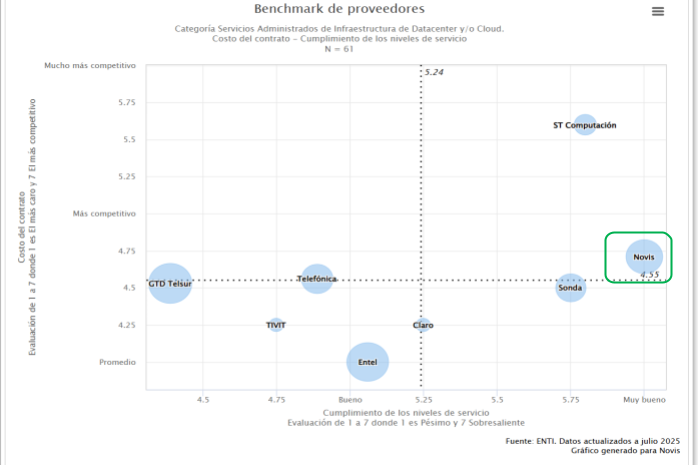
As demand grows for resilient environments —whether on-premise, hybrid, or fully cloud-based— CIOs paid particular attention to two key variables: contract cost and SLA compliance. These factors are essential, as they ensure companies receive high-quality services at fair costs and with agreed service levels.
The following chart illustrates the cross-section between these two variables, placing Novis firmly in the “High Value / High Performance” quadrant — for the third consecutive year, a clear demonstration of consistent delivery.
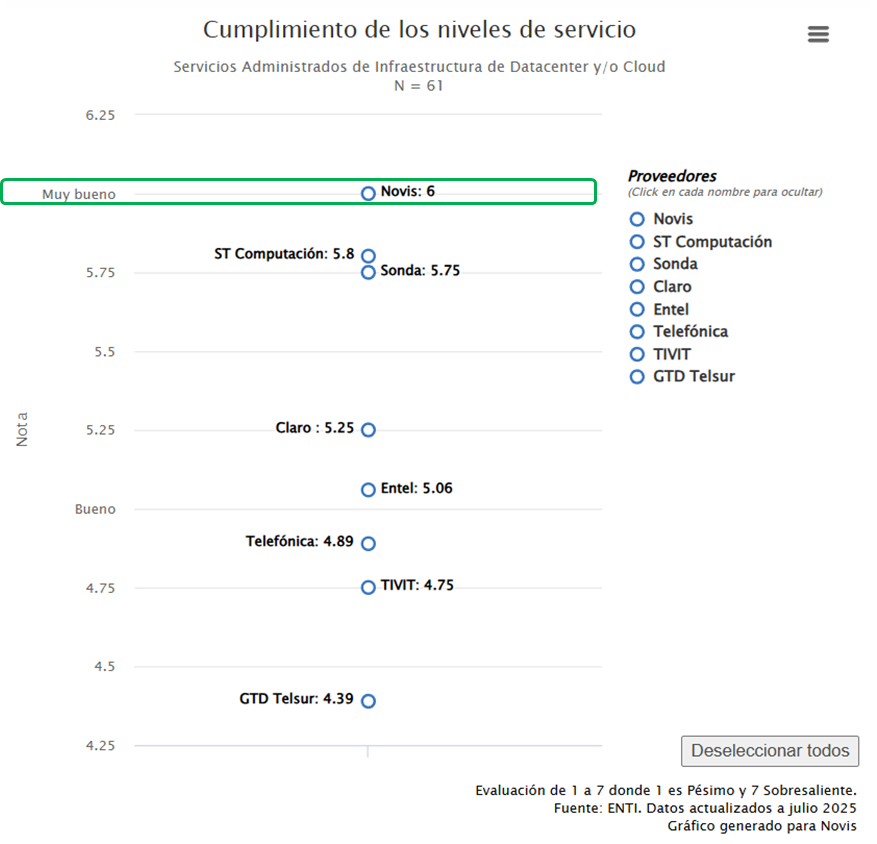
We detail below the results of other variables evaluated:
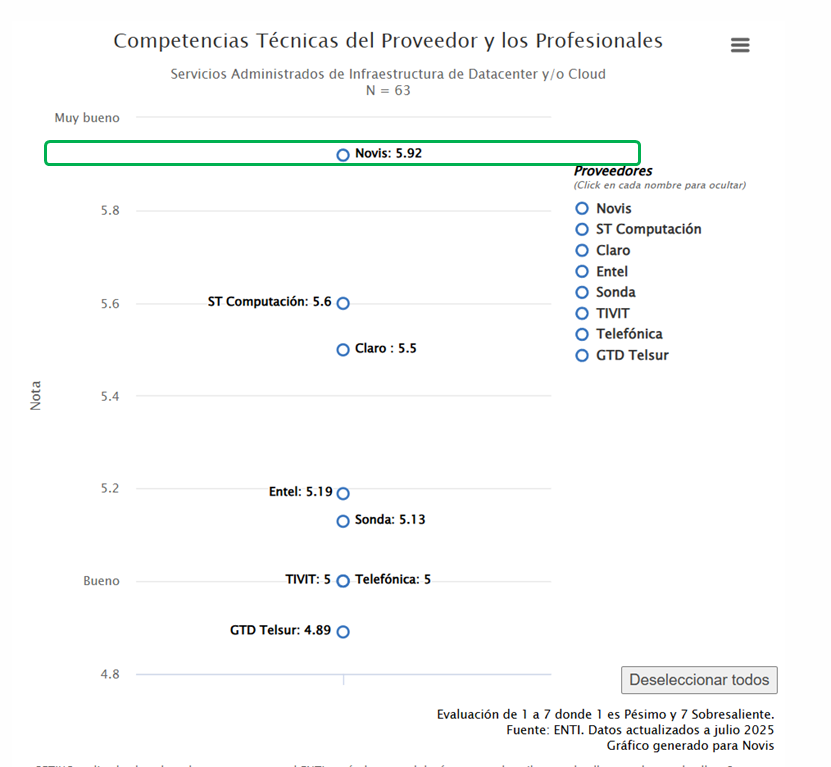
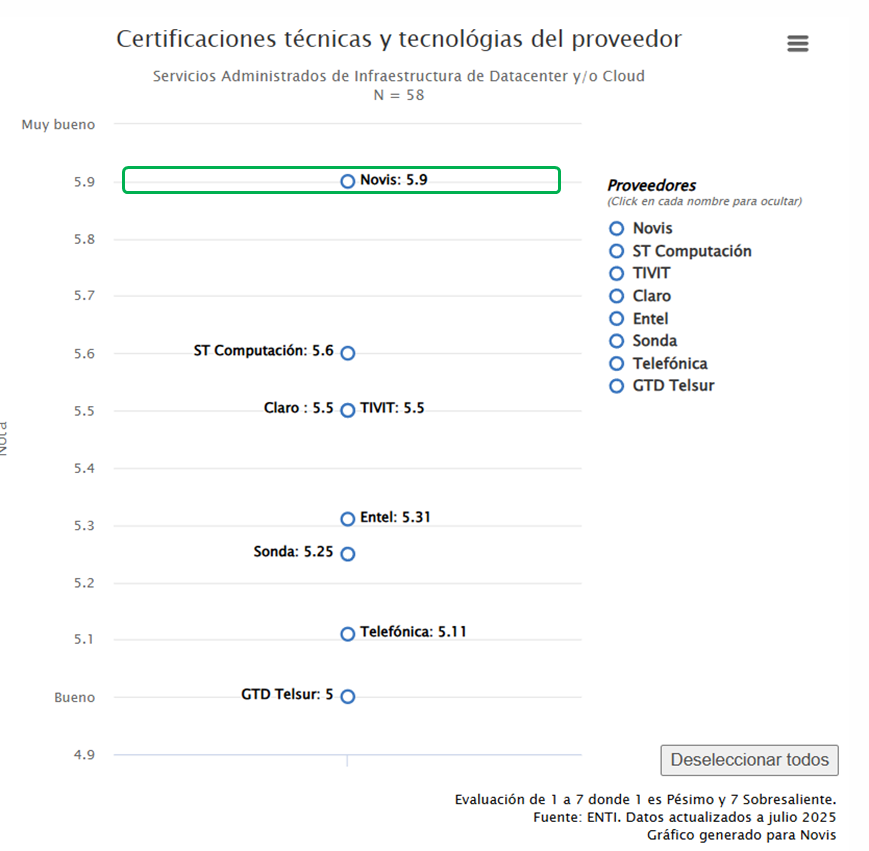
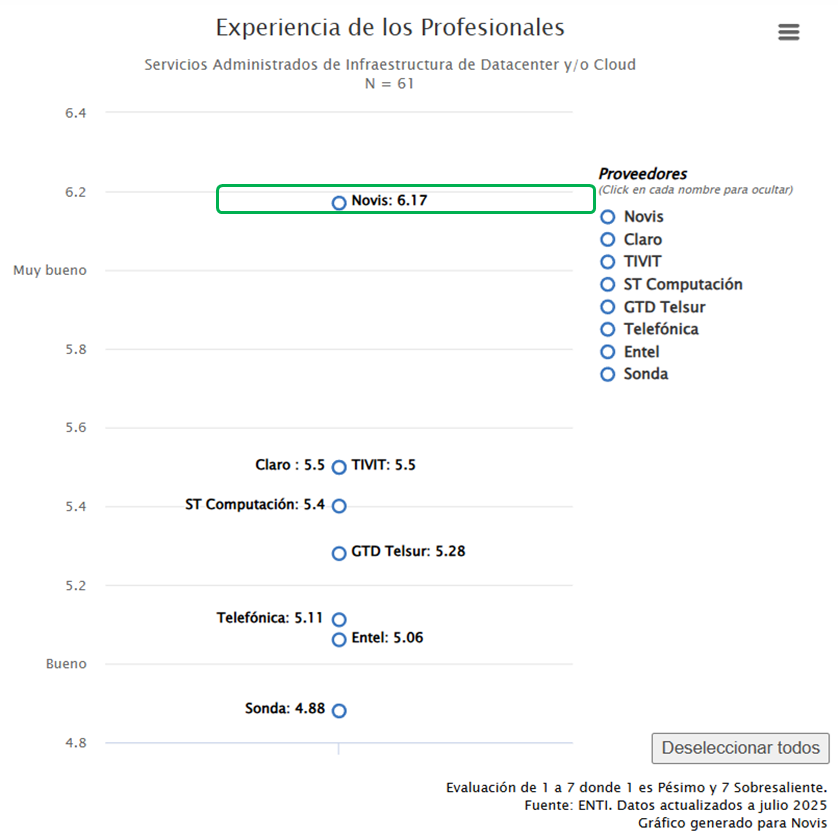
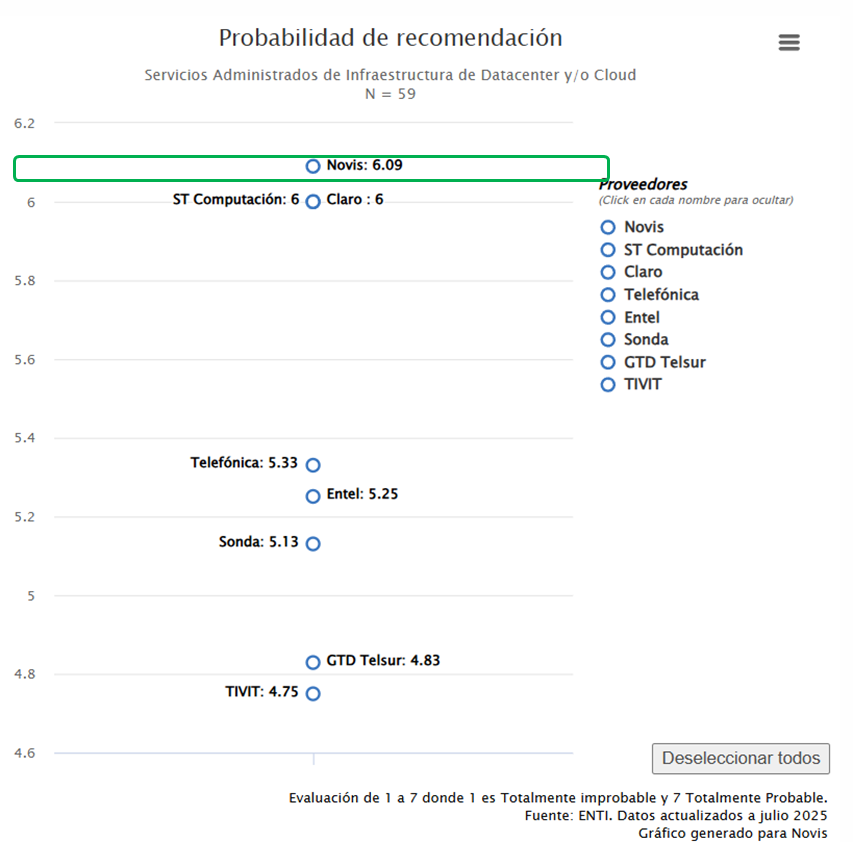
By leading in the variables most directly linked to business continuity and digital ROI, Novis consolidates its position as a strategic partner for Managed Infrastructure Services.
Novis ranks first or second in SLA compliance, technical competencies, certifications, professional experience, and recommendation likelihood — maintaining top positions in SLA since 2011 and professional experience since 2020.
Novis achieved second place in contract cost and innovation capacity, with a minimal gap from the leader — reinforcing a strong price-to-performance value proposition.
For three consecutive years, Novis has remained in the “High Value / High Performance” quadrant, demonstrating delivery stability and low supplier risk.
– Systematic SLA compliance protects mission-critical processes and prevents costly interruptions.
– Technical expertise and certifications ensure projects are aligned with best practices and industry regulations.
– A competitive cost structure, combined with continuous improvement capabilities, frees up budget for innovation.
– High recommendation rates provide confidence to executives and shareholders when selecting Novis as a trusted partner.
We invite you to contact us to discuss your Managed Infrastructure Services needs — whether on cloud or datacenter environments.
Written by Gilda Valderrama, Editor – Novis Newsletter
The Center for IT Studies (CETIUC) is a research and outreach unit of the School of Engineering at Pontificia Universidad Católica de Chile, focused on studying and promoting the strategic use of information technologies among the country’s largest organizations. Its studies and services target CIOs, general managers, boards of directors, and technology providers in both public and private sectors.
The ENTI (National IT Study) aims to provide the market with reliable, unbiased information about IT development and adoption across major organizations.
Disclaimer
CETIUC conducts the ENTI benchmarks using proprietary methodologies described in each report.
Results are based on CIO evaluations for informational purposes and do not constitute explicit or implicit guarantees. CETIUC does not endorse or recommend specific vendors based on results.
Intellectual Property Registration No. A-294086. Law N°17.336 prohibits unauthorized reproduction or use of protected works. Any form of reproduction, distribution, or public communication requires authorization from the copyright holder.
For more details, visit www.cetiuc.com.
To request a guided demo of the ENTI study, contact carlos.rojas@cetiuc.cl.
In this article, we explore why implementing AI agents in companies can transform artificial intelligence from potential into action — optimizing processes and accelerating innovation.
Artificial intelligence is no longer a futuristic promise or an experiment reserved for curious companies. In just a few years, it has moved from research labs and pilot tests to becoming a strategic tool for organizations of all sizes and industries.
According to McKinsey’s State of AI Report, 78% of global companies already use AI in at least one business function — up from 55% in 2023. This rapid growth marks one of the fastest technological adoptions in history.
The economic impact is equally undeniable: PwC estimates that AI could add up to USD 15.7 trillion to global GDP by 2030 — driving productivity, reducing costs, and creating new business opportunities once thought impossible.
But behind the numbers lies a key question: How can companies turn AI into real, sustainable results?
At Novis, we believe one of the most powerful answers lies in AI agents. They’re not new language models or just another chatbot — they’re something far more action-oriented.
An AI agent is a configurable assistant that handles specific tasks using natural language, tools, and contextual data. It not only understands what it’s asked to do — it also knows how to execute it, by connecting to different data sources and systems.
Let’s look at a real-world example:
That leap — from responding to executing — is what makes AI agents a true game-changer.
In recent months, we’ve seen many organizations start AI projects that remain stuck at the prototype stage — assistants for internal queries, bots that summarize documents, or classifiers for support tickets.
Interesting advances, yes — but they don’t transform the way the business operates.
AI agents do. By connecting to real systems, automating workflows, and coordinating actions, they stop being experiments and become active members of the operation.
And here’s the key part: they don’t require training a model from scratch. They rely on existing large language models — from OpenAI, Anthropic, Google, and others — and connect them to enterprise tools and data to build customized, goal-driven solutions.
This is the less visible — yet most critical — part.
Building a working agent is not as simple as opening an interface and typing a prompt. It requires understanding model behavior, API integration, sensitive data handling, orchestration logic, and above all, ensuring scalability and security.
Each model provider operates differently in performance, cost, and capabilities. That forces developers to learn multiple environments, write custom integrations, and adjust parameters manually — increasing both implementation time and adoption costs.
At Novis, we’ve built an operational platform that dramatically simplifies this process.
It allows our clients to:
This empowers business units to experiment and optimize independently — while the platform manages permissions, data, and security by design.
Beyond the platform, Novis offers consulting and implementation services to help organizations adopt agents strategically. This includes user training, agent blueprint definition, MCP design, RAG architecture setup, and LLM security configuration. Our approach goes beyond technology delivery — we ensure companies adopt AI effectively and sustainably, with an expert partner guiding them every step of the way.
Most companies already have access to AI — but the real value doesn’t come from having a model. It comes from putting it to work.
An AI agent is the bridge between technology and action — between potential and execution.
And with the right approach, it can move from promise to measurable competitive advantage.
At Novis, we accompany organizations throughout this journey — from use-case definition to implementation and optimization of agents that deliver real business value from day one.
We invite you to watch the recording of our webinar Enterprise AI Agent Adoption Strategy, where we explore these topics in depth.
And whenever you’re ready, contact us to discuss your next project.
Written by Cristian Marín, CTO – Novis
Cloud adoption is no longer optional — it’s an inevitable step for any company that wants to stay competitive.
However, migrating critical applications or an ERP like SAP is not as simple as “moving servers.”
It’s about redesigning processes, ensuring operational continuity, and aligning cloud costs with business strategy.
That’s where an AWS Partner comes in: a company that belongs to the AWS Partner Network (APN) and has proven — through certifications and real-world success stories — that it can carry out these tasks securely and efficiently.
Some even participate in specialized programs such as the AWS Migration Acceleration Program (MAP).
In South America, this is even more relevant. With the upcoming AWS South America Region planned for 2026, new opportunities will emerge in latency, regulatory compliance, and local resilience. Partnering with AWS today means preparing to take advantage of those benefits tomorrow.
👉 To better understand cloud cost management, check out our article: Cost Control Guide for AWS, Azure, and Google Cloud.
Not all AWS Partners offer the same value.The AWS Partner Network (APN) defines levels that distinguish the maturity and expertise of each partner:
AWS also grants specific partner competencies, such as the SAP Migration Acceleration Program (MAP) — focused on migrating and managing SAP workloads on AWS.
👉 Novis is an Advanced Tier Services Partner with SAP Competency and a member of the AWS SAP MAP program.
In short: we don’t just know the cloud — AWS officially recognizes our ability to migrate and operate SAP, one of the most critical and complex workloads.
Learn more in our AWS Certifications.
Why choose a certified partner instead of going it alone? The difference lies in tangible business outcomes.
👉 Want to go deeper? Read our Definitive FinOps Guide.
Selecting a cloud partner isn’t about the lowest quote — it’s about trust, expertise, and measurable results. Ask yourself:
👉 For a deeper look, check out our article: Cloud Services for Critical Applications: How to Choose the Right Partner.
Migrating SAP to the cloud is one of the most strategic — and challenging — decisions a company can make. Downtime, data loss, or budget overruns can have major consequences if not handled properly.
At Novis, we’ve guided enterprises through this journey using a methodology that covers the entire lifecycle: business case evaluation, migration under AWS MAP, managed operations (AMS), and ongoing optimization with FinOps.
Local success stories include:
Each case reflects a comprehensive approach: not just migration, but secure, efficient, and resilient operations after go-live.
It’s the global ecosystem of certified AWS partners specialized in building, migrating, operating, and optimizing cloud workloads.
It’s a certification recognizing proven expertise in implementing and managing SAP workloads on AWS. Novis holds this competency — ensuring official validation and technical trust.
What’s the difference between a local and a global partner?
Global partners offer scale, but local partners like Novis combine AWS backing with cultural proximity, Spanish-language support, and regulatory knowledge in the Chilean and Latin American context.
How does an AWS Partner control cloud costs?
Through FinOps practices — including rightsizing, reserved instance usage, budget policies, and consumption visibility. Learn more in our FinOps.
Adopting AWS isn’t just about moving technology — it’s about rethinking how your company operates, invests, and scales. An AWS Partner ensures you do it safely, efficiently, and with a long-term vision.
👉 At Novis, as an Advanced Tier Services Partner with SAP Competency and a member of AWS’s Migration Acceleration Program (MAP), we guide our clients end-to-end — from business case assessment to daily operations with SLA-backed services — integrating security, resilience, and FinOps best practices every step of the way.
Contact us today — we’ll help your company unlock the full benefits of the AWS platform.
Written by Gilda Valderrama, Editor – Novis Newsletter LinkedIn
Novis is thrilled to welcome Mass Ascent to our U.S. partner ecosystem. Headquartered in Virginia, Mass Ascent helps organizations “enhance productivity and secure business data with advanced licensing solutions” while keeping people first in an AI‑driven world—a vision that complements Novis’ own commitment to mission‑critical SAP and multi‑cloud managed services. Mass Ascent
Together we will offer customers an integrated portfolio that spans SAP application management, multi‑cloud architecture, software‑licensing optimisation, generative‑AI enablement, and end‑to‑end data protection. The partnership empowers enterprises across the Americas to accelerate digital transformation without compromising governance, security or cost control.
Learn more at MassAscent.com, or contact Novis to discover how our joint solutions can help your business thrive.
Mass Ascent- Helping businesses optimize user productivity and secure sensitive data with advanced cloud software and service solutions from the world’s leading companies. We keep people first in an AI-driven world!
Empresas Ariztía is a Chilean agribusiness and food group with over 130 years of family tradition. The company is vertically integrated from corn and feed production to poultry farming, slaughtering, processed product lines, and distribution—demanding robust, 24/7 available information systems. With SAP as its corporate standard, Ariztía is advancing a four-phase program to migrate its subsidiaries to this solution.
Previously on SAP version 2019, the company needed to upgrade to S/4HANA 2023 to extend SAP’s official support through 2030 and continue progressing through the next phases of its rollout.
You can listen to the full interview on Spotify or YouTube.
 “Our main challenge was operational continuity”, says Pablo Tirado, Ariztía’s Technology and Innovation Manager, recalling the performance issues experienced during phase 1 of their SAP program.
The go-live window was extremely narrow: it had to happen right after the high-demand Christmas/New Year season and before the January accounting close—without affecting sales or distribution.
| Phase | Duration | Key Deliverables |
|---|---|---|
| Exploration | 2 months | Detailed impact analysis and project timeline |
| Realization | 2 months | Remote technical and functional upgrade |
| Testing | 3 weeks | Unit and integration testing with key users |
| Post-go-live support | 1 month | Assistance with first accounting close |
Pablo Tirado explains why they chose Novis:
“Novis is currently our BASIS provider; they’ve been with us since the beginning, and we also use their AWS infrastructure.
We’ve had excellent service, and we decided to carry out this project with them as well—their know-how gave us a big advantage in implementing the upgrade quickly.”
The project was managed 100% remotely. Novis coordinated technical and functional consultants, escalated incidents directly to SAP, and led weekly committees with Ariztía to anticipate deviations.
“We held weekly meetings to detect deviations… Novis stayed with us for a full month after go-live to assist with the accounting close, which was a major milestone for the project’s success.”
“The production cutover was done over a weekend: dispatches ended Saturday at 2 p.m., work continued through Sunday at 9 p.m., and a rollback plan was in place for contingencies. Everything went smoothly—we had one issue, which was resolved on the fly, but nothing that interrupted operations. By Sunday night we were up and running. We ran full test cycles, including WMS and distribution center integrations.” Tirado summarizes.
Now running SAP version 2023, with official support through 2030.
Expanded AWS machines and increased memory improved integration performance and accounting processes.
The project was completed on time and within budget.
“I’d like to highlight the project team’s professionalism—they were rigorous in meeting deadlines and milestones, with great governance. They worked seamlessly with Ariztía’s internal IT team,” Tirado notes.
“Novis’ consulting team was a pleasant surprise: highly capable and very available. All in all, we’ve been working with Novis for over three years now, and the service has been excellent.”
“The key is in user testing; thorough, integrated testing ensures a smooth go-live. You also need to have a rollback plan,”, advises Ariztía’s CIO.
With the upgrade live and performance optimized, Ariztía moves into the second phase of its program: rolling out SAP S/4HANA to all production and back-office subsidiaries. The successful collaboration with Novis confirms that having an experienced partner—both functionally and technically—makes all the difference in critical cloud-based SAP projects.
Ariztía completed the upgrade without disrupting logistics for its 200 trucks and 45,000 active customers. With the platform now on SAP S/4HANA 2023 and optimized AWS infrastructure, the company is moving forward to phase 2: integrating all poultry operations into the same ERP system.
Want to know more about Novis services? Contact us today.
Written by Gilda Valderrama, Novis Bulletin Editor.
The public cloud is not merely a technology platform—it’s a dynamic ecosystem that powers innovation. Companies across all industries gain access to cutting-edge services like artificial intelligence, machine learning, data analytics, and more—enabling them to develop new capabilities and stand out in the market. Cloud adoption allows organizations to diversify providers and reduce dependence on monopolistic vendors. This concept was discussed six years ago in our article “Cold War Lessons for Digital Transformation.”
The cloud facilitates experimentation and adoption of emerging technologies without large upfront investments. This agility accelerates digital transformation. In addition, global access to resources and real-time collaboration among remote teams boost creativity and enable faster development of new products and services.
Migrating enterprise systems to the public cloud has become a core pillar of digital transformation. Today, more than 94% of companies use cloud services—drawn by flexibility, scalability, and cost efficiency. However, fully realizing the cloud’s potential requires specialized administration that guarantees security, continuity, and the operational efficiency of critical systems.
Managing systems in public cloud environments involves complex challenges: dealing with multiple providers (such as AWS, Azure, and Google Cloud), complying with regulatory requirements, optimizing costs, and protecting sensitive data. Specialized administration enables organizations to:
Companies like Novis offer comprehensive public cloud management services, allowing organizations to focus on their core business while ensuring the operation, security, and optimization of their systems. Their key solutions include:
Specialized cloud administration is crucial for unlocking the full potential of innovation and technology in the cloud. This ecosystem enables companies to embrace cutting-edge solutions, collaborate across borders, and evolve their operations for long-term success in the digital age. By partnering with an expert in managing cloud environments, organizations can ensure continuity, strengthen security, and drive innovation—freeing up time and resources to focus on what matters most: growth and competitive differentiation.
Author: Patricio Artiagoitia, Executive Director, Novis
Novis is a certified partner of SAP, Amazon Web Services, Microsoft Azure y Google Cloud Platform
Need help managing your public cloud systems? Contact usNeed help managing your public cloud systems? Contact us.


